

What Happens After Invisalign Treatment? Retainers, Results and Long-Term Stability

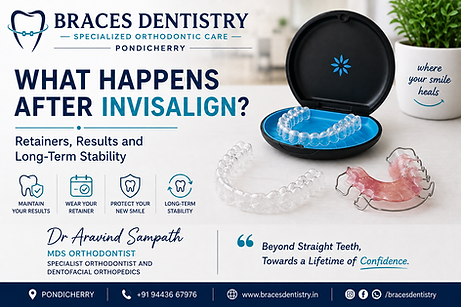
Completing Invisalign treatment can feel like the finish line. Your teeth have reached their planned positions, your smile has changed, and the aligners are no longer part of your daily routine. But orthodontic treatment does not truly end when the last active aligner is removed. The next phase is retention.
At Braces Dentistry in Pondicherry, we consider retention an important part of orthodontic treatment because achieving a good result is only one part of the process. Maintaining that result over time is equally important.
What Happens After Invisalign Treatment?
Once active Invisalign treatment is completed, your orthodontist evaluates the final result. This may include assessment of:
Tooth alignment
Bite relationships
Aesthetic outcome
Functional contacts
Treatment objectives
Stability of the final positions
If additional tooth movement is required, further aligners may sometimes be recommended. Once the desired result has been achieved, the focus shifts from active tooth movement to retention.
Why Do You Need Retainers After Invisalign?
Teeth are not permanently fixed in place simply because orthodontic treatment has finished. After teeth have been moved, the surrounding periodontal tissues and bone need time to adapt to their new positions. Even after this adaptation, teeth can naturally change position over the years. This is why retainers are prescribed.
A retainer helps maintain the positions achieved during active orthodontic treatment.
Think of Invisalign as the phase that creates the alignment, while retention helps protect the result.
Will My Teeth Move Back After Invisalign?
Some degree of tooth movement can occur after orthodontic treatment if retention is not maintained. This does not necessarily mean that the original orthodontic problem will completely return. However, gradual changes in tooth position are common over time. Several factors can contribute to post-treatment movement, including:
Natural changes associated with ageing
Growth and maturation
Soft-tissue pressures
Bite changes
Normal tooth movement
Not wearing retainers as advised
Therefore, retention is not simply an optional final step. It is an integral part of maintaining orthodontic results.
What Types of Retainers Are Used After Invisalign?
Different types of retainers may be appropriate depending on the individual patient.
Clear Retainers
Clear removable retainers resemble orthodontic aligners and are designed to hold the teeth in their final positions. They are discreet and can be removed for eating and oral hygiene.
Fixed Retainers
A fixed retainer is a thin orthodontic wire bonded to the back surfaces of selected teeth. Because it remains attached, the patient does not have to remember to put it in. However, fixed retainers require careful cleaning and periodic professional monitoring.
Combination Retention
Some patients may benefit from a combination of fixed and removable retention. The appropriate retention strategy depends on the patient's original orthodontic problem, treatment result and individual risk of relapse.
How Long Do You Need to Wear Invisalign Retainers?
There is no universal point at which everyone can simply stop wearing retainers. Orthodontic retention is generally considered a long-term commitment. Your orthodontist will determine the appropriate wearing schedule based on your treatment and individual circumstances. In many cases, the frequency of removable retainer wear changes over time rather than stopping completely. The principle is simple:
If you want to maintain your orthodontic result, you need an appropriate retention strategy.
What If I Forget to Wear My Retainer?
Occasional missed wear does not necessarily mean that treatment has been lost. However, repeated or prolonged periods without wearing a removable retainer can allow teeth to move. If your retainer suddenly feels tight, do not simply assume that it is normal. Contact your orthodontist and have the situation assessed. Depending on how much movement has occurred, your orthodontist may recommend continued retainer use, a replacement retainer or additional orthodontic treatment.
What If My Retainer No Longer Fits?
A retainer that no longer fits properly can be a sign that the teeth have moved. Do not force a retainer into position if it causes significant discomfort or does not seat correctly. Instead, have it evaluated by your orthodontist. Early intervention is generally preferable to allowing tooth movement to progress.
How Should You Clean Invisalign Retainers?
Removable retainers should be kept clean. Good retainer care includes:
Rinsing the retainer regularly
Cleaning it according to your orthodontist's instructions
Storing it in its protective case when not in use
Avoiding excessive heat
Keeping it away from pets
Avoiding unnecessary exposure to harsh cleaning agents
Hot water should generally be avoided because heat can distort some clear orthodontic appliances.
How Long Do Clear Retainers Last?
Clear retainers are not necessarily designed to last forever. They can gradually show:
Wear
Scratches
Loss of clarity
Deformation
Changes in fit
The lifespan varies depending on the material, usage, cleaning and individual habits.
Regular orthodontic reviews can help determine when replacement is appropriate.
Can I Stop Wearing My Retainers Once My Teeth Are Stable?
This is one of the most common misconceptions about orthodontic treatment. Even after the teeth have been stable for a period of time, natural changes can continue throughout life. Therefore, orthodontic retention is generally considered a long-term process rather than something with a definite end date. Your wearing schedule may change over time, but maintaining the result requires ongoing attention.
What Happens If My Teeth Start Moving Again?
Minor tooth movement does not necessarily mean that the entire Invisalign treatment needs to be repeated. If the change is identified early, your orthodontist can determine whether the existing retainer can manage the situation or whether additional correction is required. If more significant movement has occurred, additional aligners may sometimes be needed. This is another reason why retaining and monitoring the orthodontic result is important.
Invisalign Is Not Just About Straight Teeth
At Braces Dentistry, orthodontic treatment is planned with more than tooth alignment in mind. Treatment may consider:
Smile aesthetics
Facial balance
Bite
Function
Tooth position
Long-term stability
This broader approach is important because the final objective is not simply to produce straight teeth for a photograph. The goal is to achieve an orthodontic result that works well for the individual patient and can be maintained over time.
Retention and Long-Term Orthodontic Stability
A successful orthodontic result should be viewed as a long-term investment. Active treatment creates the desired tooth positions. Retention helps maintain those positions.
Regular monitoring allows potential changes to be identified before they become more significant. Together, these stages form the complete orthodontic treatment journey.
What Should You Do After Finishing Invisalign?
Once your active Invisalign treatment is complete:
Attend your final orthodontic assessment.
Confirm that your treatment objectives have been achieved.
Follow the prescribed retainer schedule.
Keep your retainers clean and protected.
Attend recommended follow-up appointments.
Contact your orthodontist if your retainer becomes damaged or stops fitting properly.
Continue maintaining good oral hygiene.
Most importantly, do not treat the last Invisalign aligner as the end of your orthodontic care. The retention phase matters.
Maintaining Your Smile After Invisalign at Braces Dentistry
At Braces Dentistry, Pondicherry, we believe orthodontic treatment should be planned beyond the active phase. Whether treatment involves Invisalign or braces, maintaining the result is an important part of responsible orthodontic care. Your retention plan is individualized according to your treatment, final tooth positions and long-term orthodontic needs.
The Bottom Line
What happens after Invisalign treatment?
The next important stage is retention. Your teeth may naturally change position over time, which is why retainers and appropriate follow-up are important for maintaining the result achieved through orthodontic treatment. Invisalign creates the transformation.
Retention helps protect it.


Comments